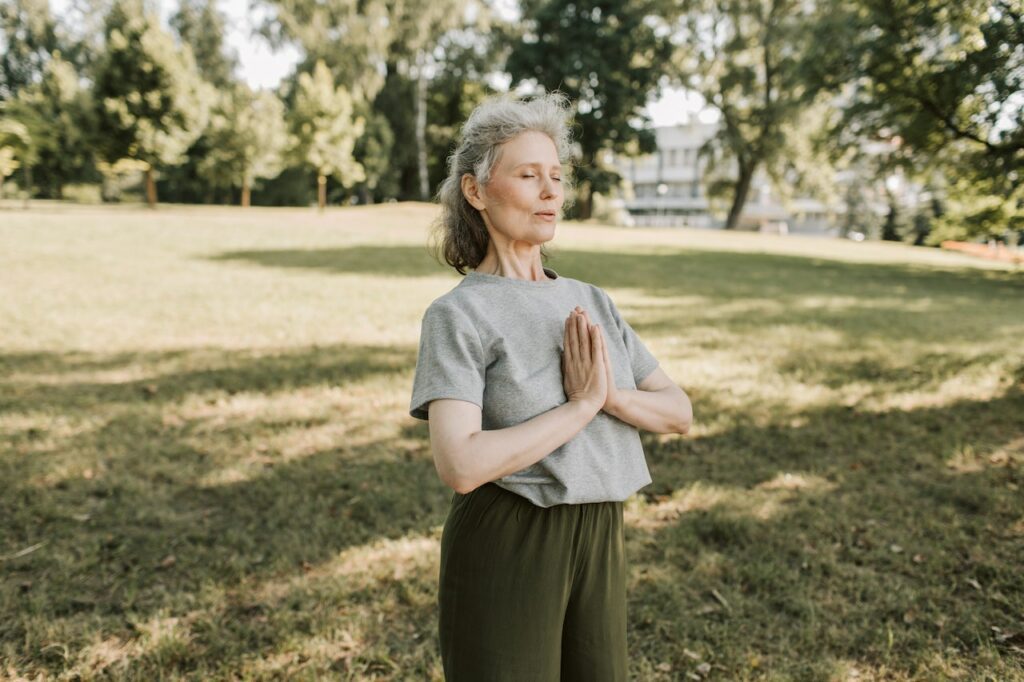
Before you read another word, I invite you to pause. Allow your eyes to soften, and notice the weight of your body settling into the chair beneath you. Feel the floor supporting your feet, steady and unyielding. Now, draw a slow breath in through your nose, tracking the cool sensation of the air, and let it out with a gentle, extended sigh. You have just taken the first step toward reclaiming your peace.
Anxiety in your later years often feels like an uninvited storm. Whether sparked by shifting health circumstances, changes in independence, or the complex emotions tied to life transitions, worry can quickly overwhelm the nervous system. You might feel a sudden tightness in your chest, a fluttering in your stomach, or a racing cascade of thoughts that refuses to slow down. During these moments, your breath remains your most faithful companion. It is an anchor you carry with you everywhere, requiring no special equipment, no physical exertion, and no monetary cost. By learning to harness the rhythm of your respiration, you can actively signal your brain to lower cortisol levels and embrace a state of profound calm.
The Foundations of Mindful Aging
Navigating the decades brings a beautiful accumulation of wisdom, but it also brings accumulated stresses. The practice of mindfulness offers a way to hold both the joy and the anxiety of aging with open hands. At its core, mindfulness rests upon three vital principles: non-judgment, focused attention, and deep self-compassion. When you experience anxiety, the instinct is often to fight it—to judge yourself for feeling nervous or to force the fear away. Mindfulness asks you to do the exact opposite. It asks you to observe the anxiety without criticism, much like watching a turbulent river flow past from the safety of a sturdy bridge.
Researchers at the Center for Healthy Minds have extensively studied how these contemplative practices alter our brain chemistry. Their data reveals that engaging in regular mindful awareness actually reshapes the neural pathways associated with emotional regulation. For seniors, this means that turning your attention to the present moment can measurably lower blood pressure and reduce the circulation of stress hormones. When you replace harsh self-criticism with compassion, you create an internal environment where your nervous system feels safe enough to stand down.
The Four Pillars of Inner Practice
To fully experience the calming effects of breathing exercises, you must first understand the four pillars of mindful practice: breath, body, emotions, and thoughts. These elements interlock to form your daily experience. Your breath is the wind, dictating the weather of your internal landscape. When your breathing is shallow and rapid, it whips up a tempest in your nervous system. When you intentionally slow the breath down, you calm the winds, allowing the dust to settle.
Your body is the earth, holding the physical sensations of your life. Anxiety often hides in tense shoulders, a clenched jaw, or a tight lower back. By directing your breath into these areas, you invite the muscles to soften and release their grip. Emotions serve as the shifting temperatures—sometimes running hot with frustration or turning cold with fear. Instead of pushing these feelings away, you can use your breath to create spaciousness around them. Finally, your thoughts represent the passing clouds. You cannot stop the clouds from moving across the sky, but you can choose whether to let them cast a shadow over your entire day. Conscious breathing anchors your attention, preventing you from getting swept away by the storm of anxious thinking.
Integrating Mindfulness into Your Daily Rhythms
True serenity does not just happen on a meditation cushion; it blossoms when you weave mindful awareness through the everyday tapestry of your life. Consider your daily routines. Perhaps you spend your mornings tending to a garden, reading the paper, or preparing a quiet cup of tea. These simple acts offer profound opportunities for presence. As you pour your morning tea, notice the steam rising from the mug, feel the warmth radiating through the ceramic against your palms, and take a deliberate, grounding breath before your first sip. This transforms a mundane habit into an active practice of anxiety prevention.
You can also carry this presence into your relationships and social interactions. Engaging with family members, adult children, or grandchildren sometimes brings its own set of stressors. When a conversation becomes overwhelming, or when you feel the familiar surge of familial tension, quietly focus on the physical sensation of your feet touching the floor. Take a smooth breath in, and let a longer breath out. This invisible practice prevents you from reacting defensively and allows you to respond from a place of grounded wisdom.
Even managing the medical appointments and health maintenance that accompany the senior years can become a mindful practice. Sitting in a doctor’s waiting room frequently triggers anticipatory anxiety. Instead of scrolling aimlessly through a phone or flipping through an old magazine, close your eyes halfway. Listen to the hum of the clinic, feel the support of the waiting room chair, and begin tracking the rise and fall of your belly. You empower yourself by taking control of your nervous system exactly when you need it most.
The Micro-Practices Library: 6 Breathing Exercises for Immediate Relief
When anxiety strikes unexpectedly, having a practical toolkit of specific breathing techniques empowers you to restore your equilibrium instantly. The following six exercises are particularly gentle, highly effective, and entirely adaptable for seniors. They do not require perfect posture or extensive physical mobility. You can practice them sitting in your favorite armchair, lying in bed, or even walking slowly through your neighborhood.
Pursed-Lip Breathing for Cooling the Nervous System
Pursed-lip breathing serves as one of the most accessible and immediate ways to slow down your respiratory rate, making it highly recommended for seniors who may also manage conditions like asthma or COPD. Imagine you hold a bowl of hot soup in your hands, and you need to cool it down with a gentle, steady stream of air. Begin by relaxing your neck and shoulders. Breathe in normally through your nose for two seconds. Then, pucker your lips as if you are about to whistle, and exhale slowly and smoothly through your pursed lips for four to six seconds. By extending the exhale, you manually engage the parasympathetic nervous system—your body’s built-in “rest and digest” mechanism. Repeat this cycle five times whenever you feel a wave of panic rising in your chest.
Diaphragmatic Belly Breathing for Deep Grounding
Anxious breathing typically occurs high in the chest, utilizing only the upper portion of the lungs. This shallow breathing signals to the brain that you are in danger. Diaphragmatic breathing reverses this signal by drawing air deep into the lowest parts of your lungs. Place one hand gently on your upper chest and the other resting on your abdomen, just below your rib cage. Inhale slowly through your nose, aiming to push your stomach out against your lower hand while keeping the hand on your chest as still as possible. Think of your belly as a balloon inflating with fresh, calming energy. Exhale gently through your mouth, feeling the balloon deflate as your stomach falls inward. This exercise physically massages the vagus nerve, which runs through your diaphragm, immediately lowering your heart rate and easing tension.
The 4-7-8 Rhythm for Evening Wind-Down
Sleep disturbances frequently accompany anxiety in the senior years, as quiet nights often leave room for loud thoughts. The 4-7-8 rhythm acts as a natural tranquilizer for the nervous system, helping you transition smoothly from wakefulness to rest. As detailed by the experts at Mindful.org, this structured pacing requires your full cognitive focus, leaving no room for anxious rumination. To begin, exhale completely through your mouth, making a soft whoosh sound. Close your mouth and inhale quietly through your nose to a mental count of four. Hold your breath gently without straining for a count of seven. Finally, exhale completely through your mouth with a whoosh sound to a count of eight. Completing four cycles of this rhythm bathes your cells in oxygen and effectively powers down an overactive mind.
Resonance Breathing for Cardiovascular Harmony
Resonance breathing, sometimes called coherent breathing, focuses on balancing the length of your inhalations and exhalations. Research demonstrates that breathing at a rate of roughly five to six breaths per minute maximizes heart rate variability, a key indicator of physical and emotional resilience. Picture a gentle pendulum swinging back and forth, entirely undisturbed by the wind. Inhale smoothly through your nose for five seconds, and then exhale smoothly through your nose for five seconds. There is no holding or pausing between the breaths; they simply roll into one another like the continuous turning of a wheel. Practicing resonance breathing for just five minutes a day trains your cardiovascular system to recover more quickly from sudden spikes of stress.
Alternate Nostril Breathing for Hemispheric Balance
When you feel overwhelmed, your brain often feels scattered and fragmented. Alternate nostril breathing originates from traditional yogic practices and serves to synchronize the left and right hemispheres of the brain, promoting clear, focused tranquility. Raise your right hand and fold your index and middle fingers down toward your palm, leaving your thumb, ring finger, and pinky extended. Close your right nostril gently with your thumb and inhale deeply through your left nostril. At the top of the breath, close your left nostril with your ring finger, release your thumb, and exhale through the right nostril. Inhale through the right nostril, close it with your thumb, release the ring finger, and exhale through the left. Continue this alternating pattern for a few minutes. You will find that this practice acts as a reset button for a cluttered, anxious mind.
Box Breathing for Steadying a Racing Mind
Box breathing provides a profound sense of structure when your world feels chaotic and unpredictable. By visualizing a square, you give your mind a geometric anchor. According to resources from the Greater Good Science Center at UC Berkeley, combining visualization with breath pacing drastically reduces the physiological markers of acute stress. Visualize the top edge of a square as you inhale through your nose for four seconds. Visualize the right edge as you gently hold the air in your lungs for four seconds. Visualize the bottom edge as you exhale completely through your mouth for four seconds. Finally, visualize the left edge as you hold the breath out, resting in the stillness for four seconds before beginning again. This exercise proves especially helpful right before entering a stressful situation, such as a difficult family conversation or a daunting medical procedure.
Measuring Progress Without Harsh Judgment
As you integrate these practices into your life, you might naturally wonder how to tell if they are working. It is crucial to measure your progress with gentle curiosity rather than harsh metrics. You are not striving for a perfect, unbroken state of zen; you are simply building a more resilient response to the inevitable challenges of life. Notice the small shifts. Perhaps you fall asleep ten minutes faster than you did last month. Maybe you catch yourself pausing to take a breath before snapping at a frustrating situation. You might simply notice the warmth of the sun on your face more vividly during your morning walk.
Celebrate these quiet victories. If you have a day where the anxiety feels insurmountable and the breathing exercises seem ineffective, offer yourself profound grace. Mindfulness is not a linear climb; it is a spiral path. Every time you return to your breath, even after losing your way in a maze of worry, you strengthen the neural pathways of peace. Your breath is always waiting to welcome you back, holding no grudges for the time you spent away.
Frequently Asked Questions About Mindful Breathing
How do I stay consistent when my daily routine frequently changes? Consistency does not require rigidity. You do not need to practice at the exact same hour every day. Instead, tie your breathing exercises to existing habits. Commit to taking three mindful breaths every time you turn on the kitchen tap, every time you stop at a red light, or right after you brush your teeth. These small anchors ensure you weave the practice naturally into whatever shape your day takes.
What should I do if taking deep breaths makes me feel dizzy or lightheaded? Dizziness usually indicates that you are pushing too hard, breathing too rapidly, or inhaling more oxygen than your body requires at that moment. If this happens, immediately return to your normal, natural breathing pattern. When you try again later, focus entirely on slowing down the exhale rather than taking massive gulps of air on the inhale. Gentle, shallow, but rhythmic breathing is far better than forceful deep breaths.
Can I still benefit from these exercises if I have respiratory limitations or conditions like COPD? Absolutely. In fact, pulmonologists often teach variations of these exact techniques to help patients manage shortness of breath. Pursed-lip breathing and diaphragmatic breathing are particularly beneficial because they help empty trapped air from the lungs and reduce the mechanical work of breathing. Always listen to your body, never force a breath that causes physical pain, and consult your physician if you are unsure.
How long does it realistically take to feel the results of these practices? You will likely feel a subtle, immediate shift in your nervous system during your very first session—a slight dropping of the shoulders or a slowing of the heart rate. However, the profound, lasting changes to your baseline anxiety levels usually emerge after three to four weeks of consistent, daily practice. Think of it like watering a dry garden; the soil takes time to soften and absorb the moisture deeply.
You carry decades of resilience, experience, and strength within you. The anxieties that surface in this season of life do not diminish your wisdom; they simply call for a new, softer way of paying attention. You do not need to fight the current of your worries. You only need to drop your anchor. May you find quiet spaces in your day to let your shoulders drop, your jaw soften, and your lungs fill with the steady, reassuring rhythm of life.
Right now, wherever you are, let us take one final breath together. Draw the air in deeply, hold it for just a moment of stillness, and release it fully into the room. You are here, you are steady, and you are entirely capable of cultivating your own peace.