You know the feeling when a chaotic morning threatens to derail your entire workday; your inbox overflows, the coffee spills, and your patience wears thin. Regaining mental clarity in these critical moments does not require sitting cross-legged on a velvet cushion for an hour chanting mantras. Instead of forcing yourself into a rigid practice you despise, you can immediately apply practical meditation techniques designed specifically for restless, busy minds. Integrating these actionable, science-backed mindfulness strategies directly into your commute, your workflow, and your evening routine permanently alters your stress response. By fundamentally redefining what it means to be mindful, you rapidly build emotional resilience and sharper focus without ever feeling like you are meditating.
What Mindfulness Actually Means In Your World
Many people abandon meditation entirely because they drastically misunderstand its core purpose; they falsely assume it requires achieving a state of complete mental blankness. This widespread misconception sets you up for inevitable failure before you even close your eyes. Mindfulness does not demand a perfectly serene environment, nor does it require you to empty your brain of all passing thoughts. Instead, it serves as a highly practical tool for attention management in an increasingly distracted, fast-paced world.
When you redefine mindfulness as the simple, deliberate act of noticing where your attention goes, the practice immediately becomes more accessible and far less intimidating. You do not need to silence your chaotic thoughts to experience the distinct benefits of a grounded mind. You merely need to catch your mind when it wanders toward anxiety, frustration, or rumination, and then gently steer your focus back to the present moment. This subtle but powerful pivot empowers you to reclaim total control over your emotional reactions throughout your demanding day.
By stripping away the mystical baggage often associated with traditional meditation, you uncover a pragmatic skill set designed specifically for the modern professional. You can actively practice this skill while waiting for a virtual meeting to start, while folding a pile of laundry, or while simply walking from your car to the front door. True mindfulness integrates seamlessly into your existing, packed routine, acting as an invisible buffer against chronic stress without ever demanding significant chunks of your valuable time.
The Science Snapshot: Why You Should Bother
Skeptics often dismiss meditation as a fleeting wellness trend, but decades of rigorous scientific research prove otherwise. Regular mindfulness practice physically alters the architecture of your brain, specifically targeting the complex neural pathways responsible for stress and emotional regulation. You absolutely do not need to practice for hours a day to trigger these positive neurological changes; micro-doses of focused attention yield highly measurable, life-altering results.
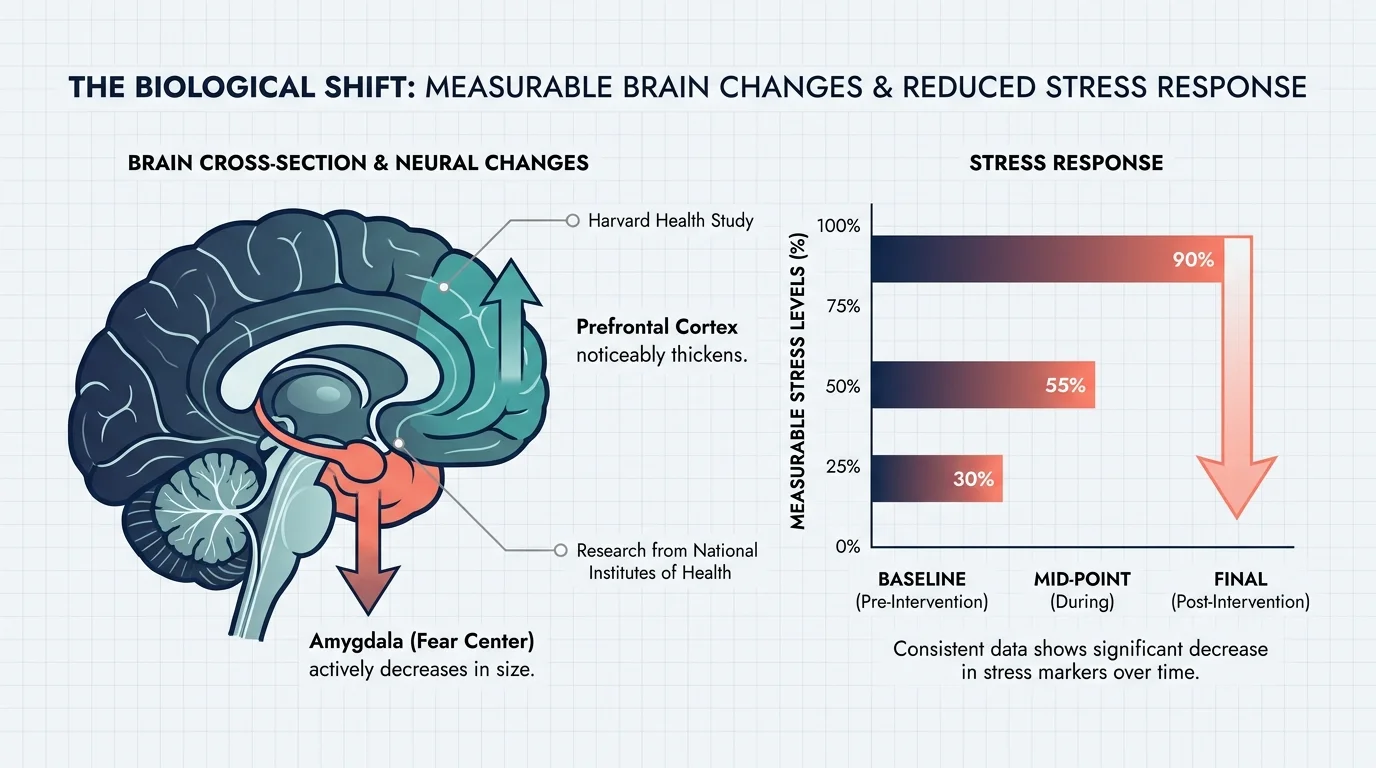
According to a study from Harvard Health, consistent mindfulness practice actively decreases the size and reactivity of the amygdala, which operates as the primal fear and anxiety center of your brain. As this specific region shrinks over time, your prefrontal cortex noticeably thickens, greatly enhancing your natural ability to concentrate, solve complex problems, and make rational decisions under intense pressure. This profound biological shift explains exactly why mindful individuals bounce back from daily frustrations with significantly greater ease than their chronically stressed peers.
Furthermore, physiological markers of bodily stress dramatically improve when you incorporate brief, meditative moments into your hectic schedule. Compelling data supported by research from the National Institutes of Health demonstrates that basic mindfulness interventions effectively lower blood pressure, reduce resting heart rates, and decrease the systemic production of cortisol. These tangible, undeniable health benefits strongly validate the practice, proving that even a highly reluctant meditator can drastically improve their long-term physical wellbeing through small, consistent mental interventions.
7 Meditation Techniques For People Who Dislike Meditating

Technique 1: The One-Minute Transition Pause
Moving frantically from one demanding task to the next leaves your central nervous system in a state of perpetual, exhausting high alert. You likely finish a tense phone call and immediately open an aggressive email, never giving your overwhelmed brain a single moment to process the emotional whiplash. The transition pause forces you to intentionally insert a protective buffer between your daily obligations, stopping the snowball effect of mounting anxiety.
Before you physically shift environments—whether stepping out of your home office or logging into yet another virtual meeting—you must simply stop moving for sixty seconds. Plant your feet firmly on the ground, take three intentionally deep breaths, and mentally acknowledge the final completion of your previous task before beginning the next one. This microscopic boundary prevents the lingering stress of your turbulent morning from aggressively bleeding into your afternoon.
Technique 2: Anchored Habit Stacking
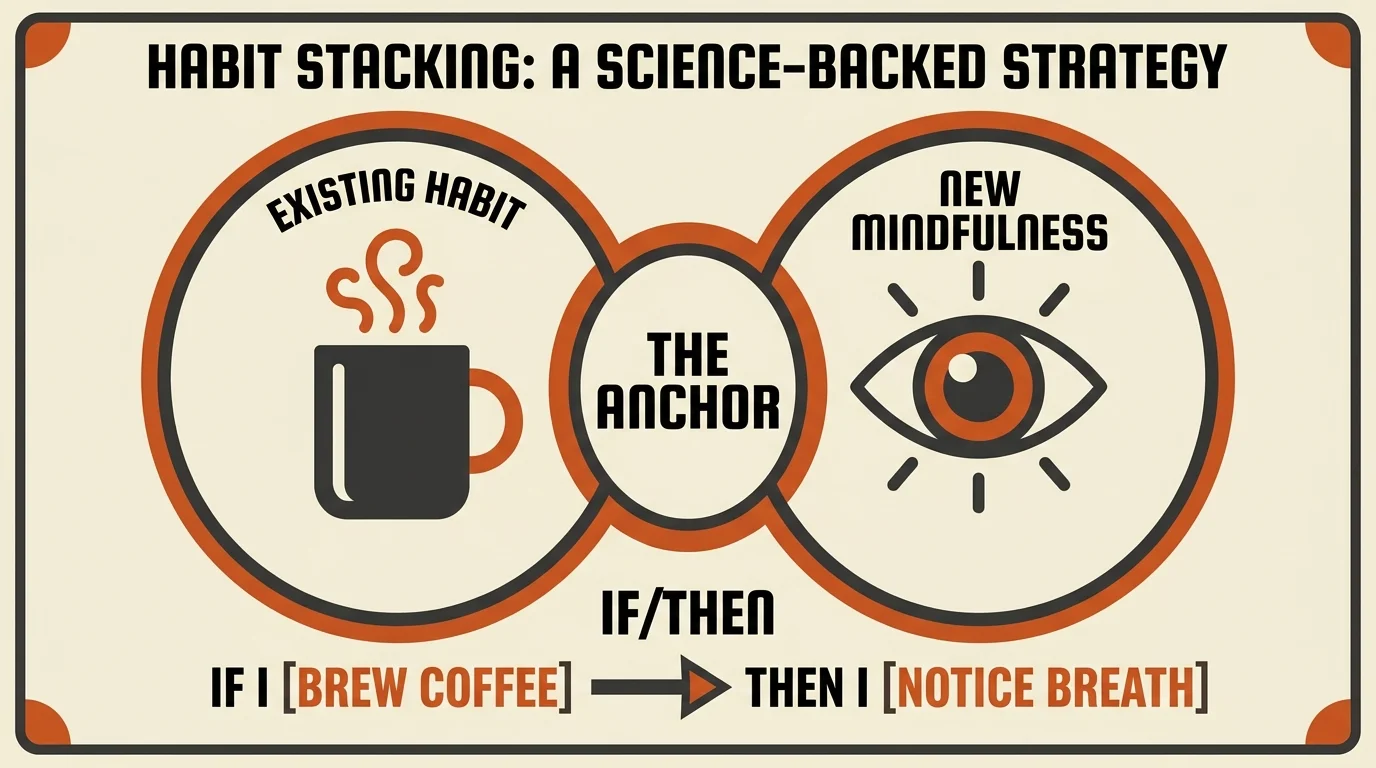
Finding extra time to build a brand new wellness routine often feels entirely impossible when your calendar is already overflowing with commitments. Anchored habit stacking brilliant eliminates the need to carve out dedicated, uninterrupted meditation time by attaching mindfulness directly to an activity you already perform every single day. You simply transform an automatic, mindless chore into a deliberate, highly focused sensory experience.
Consider the daily act of brewing your morning coffee or washing the lingering dinner dishes. Instead of letting your unanchored mind race toward your looming deadlines or financial worries, focus your attention entirely on the physical sensations of the immediate task. Notice the exact temperature of the water running over your hands, the rich aroma of the ground coffee beans, or the rhythmic sound of the machine humming; whenever your thoughts inevitably drift back to your inbox, actively pull your attention back to the physical chore.

Technique 3: Tactical Sensorial Grounding
Anxiety thrives on future-tripping, aggressively pulling your mind into worst-case scenarios and hypothetical disasters that have not yet happened. Tactical sensorial grounding immediately short-circuits this vicious anxiety loop by forcing your brain to process immediate, factual environmental data. You can perform this discreet technique invisibly during a stressful highway commute, a chaotic family dinner, or a tense board meeting.
Scan your immediate surroundings and silently identify five specific things you can visually see, such as the rough texture of the wall or the distinct color of a colleague’s shirt. Next, actively identify four distinct sounds competing for your attention, three physical sensations you can currently feel, two things you can vividly smell, and one thing you can actively taste. This structured, sensory exercise acts as a highly effective emergency brake for a racing mind, firmly returning your focus to a safe, tangible reality.

Technique 4: Active Moving Meditation
Sitting completely still entirely terrifies people who possess restless energy or hyperactive, endlessly analyzing minds. If closing your eyes and sitting silently on the living room floor makes you want to crawl out of your skin, you should immediately embrace active moving meditation. This dynamic approach directly harnesses your natural physical momentum to effectively quiet your internal mental chatter.
Take a brisk walk around your local neighborhood without bringing your phone, a podcast, or a motivating playlist. Focus your undivided, singular attention on the pure mechanics of your bodily movement—the precise way your heel strikes the hard pavement, the natural swing of your arms, and the steady rhythm of your breath matching your striding pace. When you deliberately channel your excess nervous energy into continuously observing your physical body, the overwhelming mental static naturally begins to clear away.
Technique 5: Micro-Breathing Through Friction
Daily irritations provide perfect, built-in opportunities to practice crucial emotional regulation without requiring any formal schedule or dedicated space. You encounter infuriating micro-friction constantly: waiting in a stubbornly slow grocery checkout line, sitting in gridlocked rush-hour traffic, or dealing with a painfully slow internet connection. Most modern adults fill these uncomfortable gaps with mounting internal frustration or mindless, dopamine-seeking smartphone scrolling.
Instead of aggressively fighting the unavoidable delay, use the daily friction as an immediate, psychological trigger for targeted breathwork. Inhale slowly and deeply through your nose for a solid count of four, hold the breath briefly for a count of two, and exhale fully through your mouth for an extended count of six. By purposefully extending your exhale, you directly stimulate your parasympathetic nervous system, instantly lowering your elevated heart rate and transforming a highly annoying delay into a brief nervous system reset.

Technique 6: The Audio Deep Dive
Music holds profound, unparalleled power over human emotion, making it an incredibly excellent vehicle for sneaky, highly effective meditation. The audio deep dive requires you to engage with a selected piece of music critically and entirely, rather than merely using it as pleasant background noise while you work. You must select a complex, preferably instrumental track and commit your entire cognitive load to closely analyzing its hidden layers.
Put on a pair of high-quality headphones, close your eyes to eliminate visual distractions, and listen to the song with intense, unwavering curiosity. Try to mentally isolate individual instruments; follow the driving bassline for thirty full seconds, then actively shift your focus entirely to the complex percussion or the sweeping string section. This intense, isolated auditory focus closely mimics the deep concentration required for traditional meditation, expertly training your brain to sustain unbroken attention on a single anchor point.
Technique 7: Tension Release Body Scanning
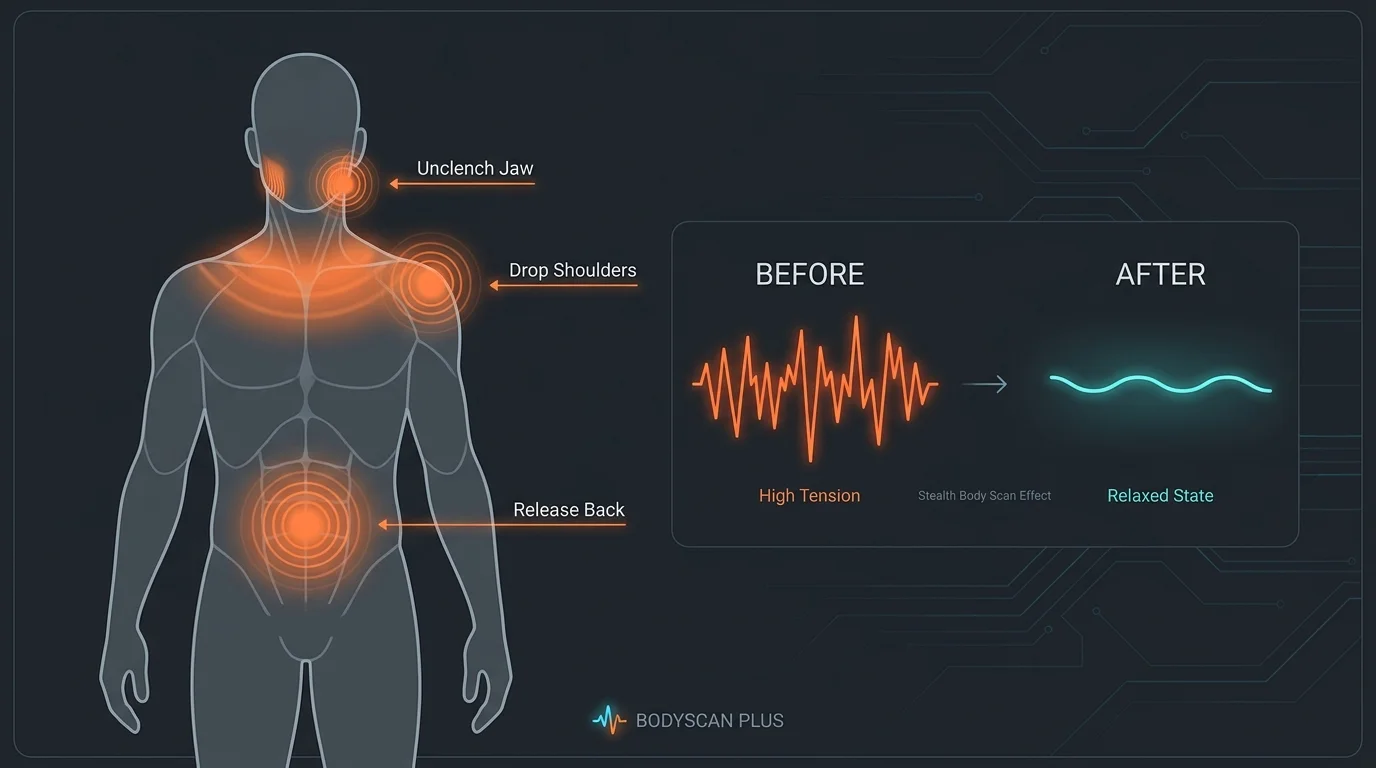
Stress notoriously hides deep within your physical body long before your conscious mind actively recognizes the heavy emotional burden you carry. You probably clench your jaw tightly, hike your tense shoulders up toward your ears, or hold painful tension in your lower back while staring blankly at your glowing computer monitor. The tension release body scan helps you quickly identify and systematically release this trapped, painful physical stress.
Starting from the very crown of your head, slowly direct your focused attention downward through each major muscle group, actively searching for specific areas of tightness or discomfort. When you inevitably encounter a tense area, intentionally flex the muscle even tighter for three agonizing seconds before completely and suddenly letting it go. This active, deliberate contraction and release cycle forces you to deeply reconnect with your physical form, providing immediate, soothing relief from accumulated somatic stress.
Your Daily Integration Framework
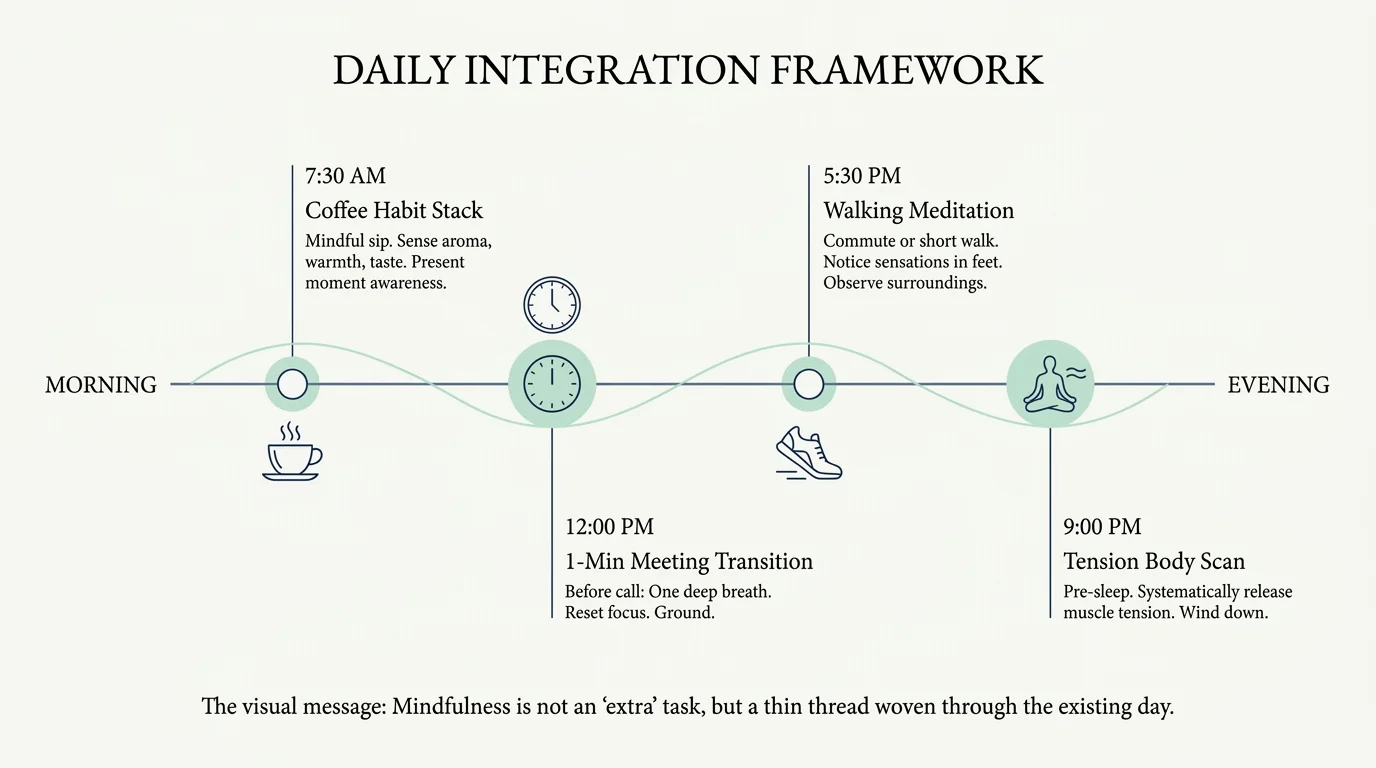
Adopting these practical techniques requires a reliable, deeply ingrained framework to ensure they actually stick as permanent habits. You absolutely cannot rely on fleeting willpower alone to remember to be mindful when an unexpected crisis hits your desk. The most remarkably successful habit formation strategies involve the simple, repetitive sequence of pause, observe, and respond. You can easily weave this powerful framework effortlessly into the existing fabric of your busy day.
During your chaotic workday, aggressively use the pause phase whenever you switch between critical software applications, hang up a phone call, or finish a demanding meeting. Observe your current emotional state completely without judgment, taking careful note of any brewing frustration, shallow breathing, or false urgency gripping your chest. Finally, respond proactively by deploying a micro-breathing technique or a quick physical tension release before you launch headfirst into your next major project. This deliberate, paced sequence permanently transforms your workflow from a series of reactive, exhausting fire drills into a structured, highly intentional process.
You can seamlessly apply this exact same framework to your precious personal time and your most important family relationships. When you finally arrive home, intentionally pause in the driveway before walking heavily through the front door. Observe any lingering professional stress weighing on your mind, and consciously choose to leave it locked in the car so you can respond to your loved ones with genuine, focused presence. These tiny, intentional frameworks consistently build incredible emotional resilience and relational depth over time.

Overcoming Common Mindfulness Obstacles
Even with highly practical techniques firmly at your disposal, you will inevitably encounter strong mental resistance when trying to establish any new wellness routine. The most pervasive, universally cited obstacle is the deeply held belief that you simply lack the necessary time to meditate. However, because the specific strategies outlined above require only minutes—or sometimes merely seconds—perceived time constraints rapidly become a completely invalid excuse. You simply need to reallocate the scattered, wasted moments you currently spend agonizing over your overflowing to-do list or doom-scrolling on social media.
Another incredibly significant barrier is the intense frustration of dealing with a relentlessly wandering, hyperactive mind. You might try the complex audio deep dive and suddenly realize you spent half the song anxiously planning your weekly grocery list. According to data published by the American Psychological Association, recognizing that your mind has wandered is actually the ultimate core metric of success in any mindfulness training. Every single time you actively notice your distraction and deliberately pull your focus back, you successfully complete a valuable, strengthening “rep” for your changing brain.
Finally, deep-seated skepticism heavily prevents many pragmatic, logically driven individuals from fully committing to the long-term process. If you stubbornly demand immediate, life-altering results from a single sixty-second breathing exercise, you will undoubtedly feel deeply disappointed. You must patiently approach these techniques with the clear understanding that mindfulness operates exactly like physical weightlifting; the life-changing benefits accumulate slowly through consistent, unglamorous daily repetition rather than through grand, sweeping, one-time efforts.

The Long-Term Benefits of Sneaky Meditation
When you consistently practice these subtle, invisible interventions, you slowly but permanently rewire your baseline emotional responses to daily adversity. You gradually stop reacting explosively to minor inconveniences and start confidently navigating daily chaos with a steady, wonderfully unbothered calm. This newfound, ironclad emotional resilience aggressively protects your limited energy, allowing you to direct your sharpest focus toward the critical tasks and meaningful relationships that genuinely matter.
Beyond massive improvements in emotional stability, your baseline cognitive performance sharpens significantly and noticeably. Chronic, unmanaged stress actively destroys your inherent ability to concentrate, severely fracturing your attention span and rapidly diminishing your vital working memory. By firmly implementing regular transition pauses and tactical sensorial grounding exercises, you effectively clear away the thick mental clutter that directly causes debilitating brain fog. You will find it remarkably easier to enter lucrative states of deep work and proudly sustain your peak productivity without constantly relying on endless cups of caffeinated coffee.
Ultimately, the absolute greatest benefit of this highly pragmatic approach is the profound, undeniable sense of personal agency it fully restores to your busy life. You no longer operate as a helpless, passive victim of your demanding professional schedule or your wildly fluctuating internal moods. By utilizing experts at the Mayo Clinic guidelines for holistic stress management indirectly through these sneaky daily habits, you arm yourself with a remarkably robust toolkit for maintaining your absolute wellbeing in any challenging environment.
Frequently Asked Questions
Do I need to close my eyes to properly meditate?
You absolutely do not need to close your eyes to successfully achieve a deeply beneficial state of mindfulness. In fact, many highly active techniques, such as tactical sensorial grounding and active walking meditation, explicitly require your eyes to remain fully open and alert. If closing your eyes artificially makes you feel uncomfortably vulnerable or heavily drowsy, simply maintain a soft, entirely unfocused gaze on a stationary, neutral object directly in front of you while you practice.
How long does it actually take to see tangible results?
The overall timeline for highly noticeable, lasting benefits varies dramatically depending on your daily consistency and your personal baseline stress levels. While a single, focused deep breathing exercise provides immediate, temporary, soothing relief for your overwhelmed nervous system, lasting structural changes in the brain typically require several consistent weeks of daily practice. Focus entirely on building the simple habit first, and the compounding, highly rewarding cognitive benefits will naturally and inevitably follow.
What should I do if my mind simply will not stop racing?
A rapidly racing mind is incredibly common, especially when you first boldly begin paying close attention to your chaotic internal dialogue. Do not aggressively fight the racing thoughts or harshly scold yourself for having them, as this negative reaction only generates significantly more anxiety and tension. Simply label the intrusive thoughts clearly as “thinking,” politely acknowledge their passing presence, and gently redirect your wavering attention to your chosen sensory anchor, whether that is the rhythm of your breath or a specific physical sensation.
Does practicing these techniques while doing chores actually count?
Yes, seamlessly integrating mindfulness into your mundane daily chores absolutely counts as highly valid, effective meditation. The ultimate, overarching goal of mindfulness is to strongly cultivate present-moment awareness, regardless of your physical posture, your location, or your current activity. When you carefully fold laundry or wash dishes with deliberate, undivided, total attention, you successfully train your brain to focus just as effectively as someone actively sitting in perfectly silent, formal contemplation.
Your Next Steps For A Calmer Mind
You already fully possess all the internal tools necessary to cultivate a deeply grounded, highly resilient mindset without ever forcing yourself into a traditional, uncomfortable meditation practice. The ultimate secret to your success lies entirely in abandoning rigid perfectionism and fully embracing the messy, highly realistic integration of mindfulness into your relentlessly busy daily life. You absolutely do not need to adopt all seven outlined techniques simultaneously; instead, simply select the single strategy that currently feels most approachable and bravely test it during your very next stressful moment.
Start remarkably small by intentionally committing to just one single transition pause or one brief habit-stacked routine tomorrow morning. As you eagerly begin to notice the incredibly subtle, positive shift in your daily emotional stability, you will naturally want to continuously expand your mental toolkit. Remember that true, lasting mental clarity comes not from desperately escaping your wonderfully busy life, but from finally learning exactly how to anchor yourself firmly and confidently within it.